


Nature - 2019 August - Vol 572 No 7770
Publisher: Nature
Format: Paperback
ISBN: 9770028083095
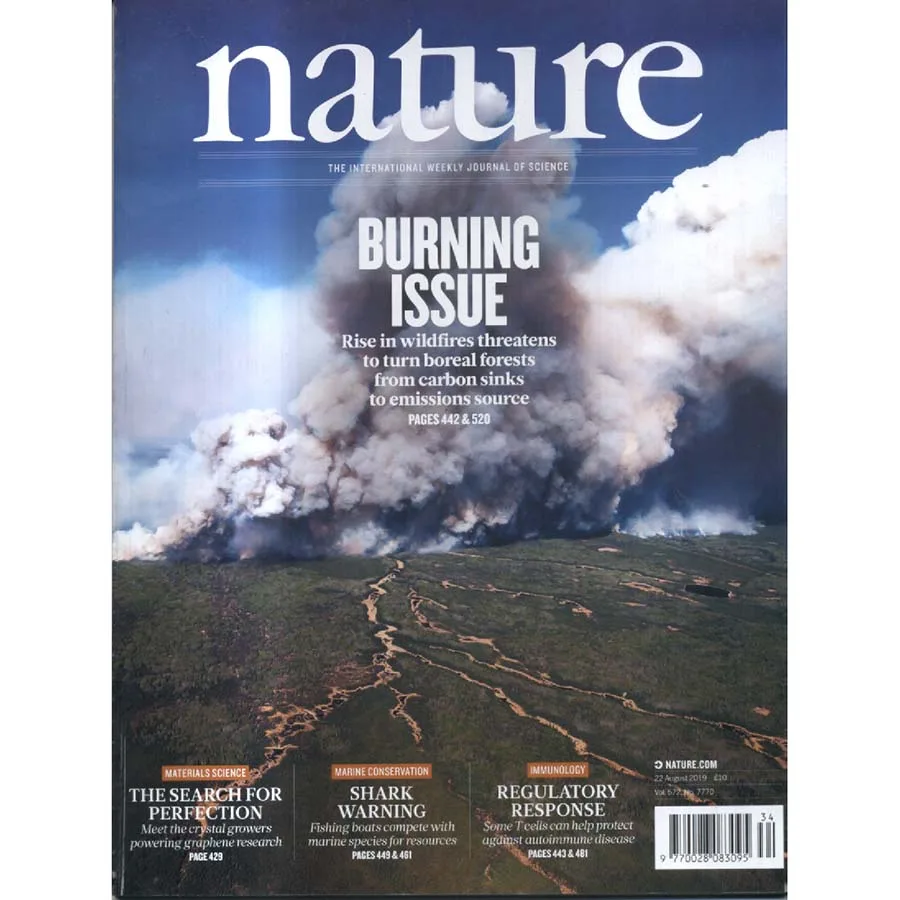
There is something uniquely unsettling about old issues of Nature magazine because they often read like highly intelligent warnings humanity glanced at briefly before wandering off to argue about entirely the wrong things. Nature – August 2019 arrives carrying exactly that energy, featuring a cover headline so ominously direct — BURNING ISSUE — that one almost expects the planet itself to sigh heavily in the background.
And the cover image does not believe in subtlety.
An enormous wildfire rolls across the landscape in vast clouds of smoke while the magazine calmly explains that boreal forests risk transforming from carbon sinks into carbon sources. In other words, forests may eventually stop helping us with climate stability and instead begin assisting the apocalypse. Cheerful summer reading for the scientifically literate.
The remarkable thing about Nature is its refusal to sensationalise while simultaneously presenting information that, if properly understood, should probably cause at least mild existential concern. There is no dramatic tabloid language here. Just measured scientific analysis quietly informing readers that several planetary systems may be behaving somewhat alarmingly.
Elsewhere in the issue:
-
graphene researchers pursue perfection,
-
fishing boats compete destructively for marine resources,
-
immunologists investigate autoimmune disease,
-
and countless scientists continue attempting to hold civilisation together using mathematics, laboratories and improbable amounts of coffee.
One cannot help admiring them.
Reading science magazines from 2019 now carries a peculiar emotional atmosphere. It was a strange threshold year: climate anxiety intensifying, technology accelerating and scientific understanding deepening rapidly, all just before the world collectively wandered into a pandemic and permanently altered its relationship with science, expertise and public trust.
This issue therefore feels oddly prophetic. Wildfires dominating landscapes. Environmental instability. Resource pressure. Complex biological systems under strain. The cover almost resembles a cinematic trailer for the decade that followed.
And yet Nature remains wonderfully calm about everything. Scientific journals possess a unique ability to discuss civilisation-scale problems with the emotional tone of someone explaining minor plumbing concerns. Entire ecosystems may be destabilising, but the typography remains elegant and peer-reviewed professionalism continues uninterrupted.
The visual design is magnificent too. Modern scientific publications increasingly resemble high-end art magazines because reality itself has become visually dramatic under advanced imaging and environmental photography. Smoke plumes, molecular structures and climate systems now arrive packaged with astonishing aesthetic sophistication, as though the universe itself has hired a graphic design team.
There is also something deeply ironic about buying old issues of Nature second-hand. These magazines were originally produced for cutting-edge scientific readerships — researchers, institutions, academics and intellectually ambitious subscribers determined to remain informed about humanity’s latest understanding of reality. Years later they become cultural artefacts found in second-hand bookshops, where readers can experience the exact moment scientists calmly explained future problems that everybody else was too distracted to process properly.
Physically, this issue has all the reassuring seriousness one expects from Nature: dense articles, immaculate editorial standards and enough advanced terminology to make ordinary readers feel simultaneously fascinated and educationally inadequate. It is the intellectual equivalent of walking into a laboratory and realising everyone else understands the equations.
Condition-wise, this copy is listed as Good, meaning it has survived admirably despite likely exposure to university desks, laboratories, office coffee and at least one owner who probably intended to read the graphene article thoroughly before becoming emotionally overwhelmed by global ecological collapse around page 442.
Today, Nature – August 2019 stands not merely as a science journal, but as a snapshot of humanity attempting to scientifically document the changing world in real time while still clinging optimistically to the idea that knowledge might help us avoid setting absolutely everything on fire.
An excellent acquisition for science enthusiasts, climate historians, collectors of intellectual ephemera or anyone who enjoys publications capable of making them feel simultaneously informed, anxious and oddly grateful that at least somebody was paying attention.
Keep browsing: See more Nature Journal books Other books by Nature
